" ... their damn guns bursting and booming all over the shop especially the Queen's birthday..."
[Molly reminiscing about Gibraltar, late at night on June 16, 1904.]
n/ U (Gabler) 18:679-80.
Firing the Guns in Marion Tweedy's Gibraltar
At the start of 1879, the regiment was in Maryhill Barracks in Glasgow's northern suburbs. On May 15th, the War Office ordered it to embark for Gibraltar. At the time, the Camerons were understrength with 20 officers, 35 sergeants, 18 drummers, and only 485 rank and file. The regiment arrived in Gibraltar on June 15th. As shown in the Gibraltar Directory, the unmarried officers were quartered in the Spanish Pavillion, in the Town's center adjacent to the Roman Catholic Cathedral, Santa Maria.
The Artillery of Fortress Gibraltar
At the start of 1879, the regiment was in Maryhill Barracks in Glasgow's northern suburbs. On May 15th, the War Office ordered it to embark for Gibraltar. At the time, the Camerons were understrength with 20 officers, 35 sergeants, 18 drummers, and only 485 rank and file. The regiment arrived in Gibraltar on June 15th. As shown in the Gibraltar Directory, the unmarried officers were quartered in the Spanish Pavillion, in the Town's center adjacent to the Roman Catholic Cathedral, Santa Maria.
Firing Batteries, 1904
Click on the image for a large version in a popup window.
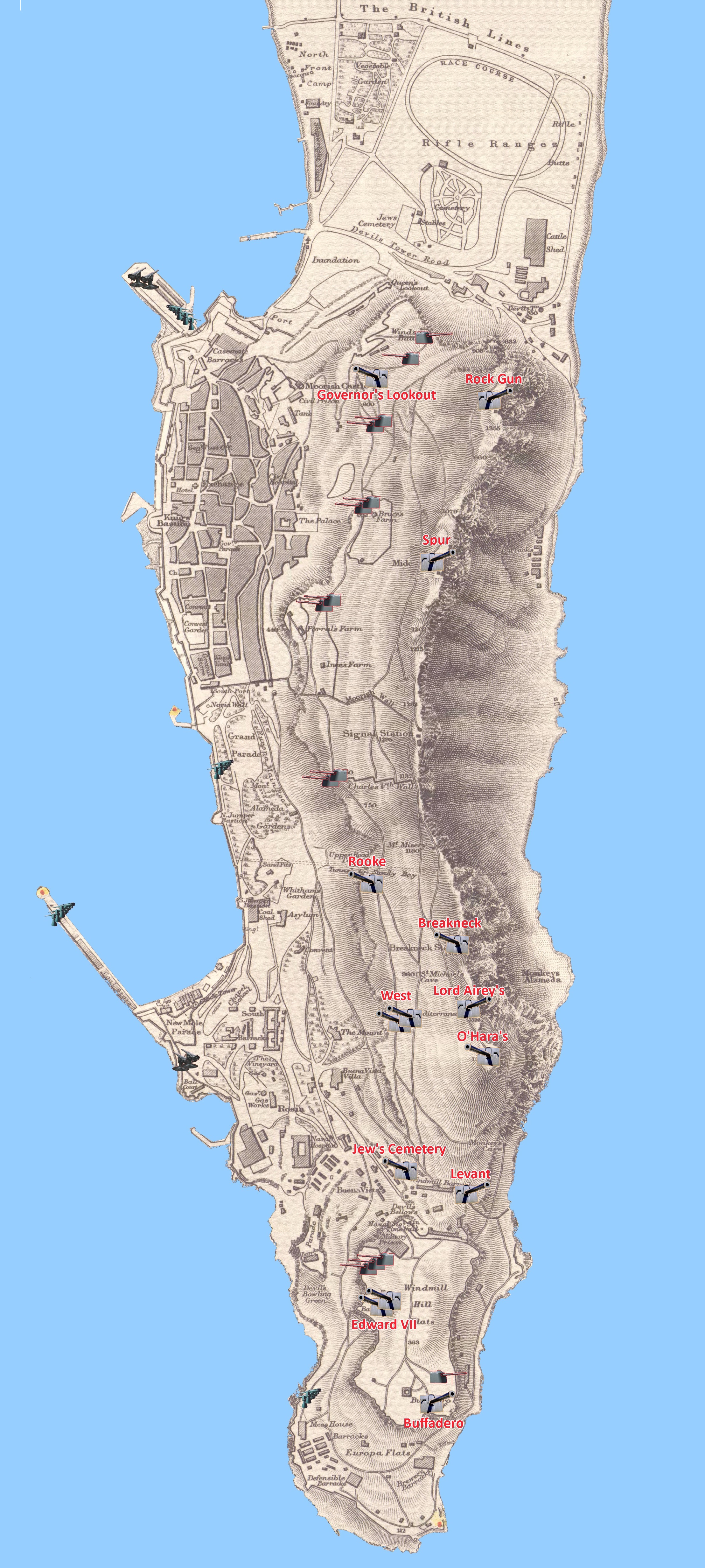
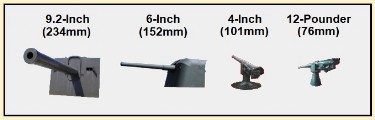
Gibraltar map from an 1886 Admiralty Chart.
Later in the year, the regiment received news of the soon to be implemented regimental amalgamation scheme whereby they would be the 2nd Battalion of a new regiment with the 42nd (Black Watch) the 1st Battalion. The regimental tartan would be that of the Black Watch. The Camerons, all ranks, opposed such amalgamation.
In January 1881, the acting commander, Lt.-Col. J.M. Leith, telegramed the War Office: "No. - The Cameron Highlanders will not adopt the 42nd tartan." Col. Leith then wrote to the Adjutant-General as follows:
Artillery at Selected Fortified Ports, 1904
Designation | Caliber | Plymouth Home Fleet | Cork Harbour Anchorage | Gibraltar * | Malta Med. Fleet | Hong Kong Pacific Station | |
| 9.2 Inch | 234mm | 14 | 4 | 14 | 16 | 8 | |
| 6 Inch | 152mm | 19 | 6 | 14 | 14 | 11 | |
4 Inch | 101mm | 2 | 0 | 4 | 0 | 0 | |
| 12 pounder | 76mm | 23 | 8 | 10 | 12 | 0 | |
Total | 58 | 18 | 42 | 42 | 19 |
* In 1909, after completion of the multi-year Naval Base expansion, the Admiralty made Gibraltar HQ for the newly formed Atlantic Fleet.
Joyce includes the Cork Harbour fortifications in Ulysses through the purported sailor D.B. Murphy's mention of Fort Camden and Fort Carlisle in "Eumaeus" and through the narrator of "Ithaca." Those forts were two of the four fortified positions that protected the Cork Harbour Naval Anchorage (the other two were Fort Westmoreland and Templebreedy Battery).
n/ U (Gabler) 16:418, 17:1975-76.
Note that the lighter guns at Gibraltar (4-inch and 12-pounder) were comparable to the Royal Artillery's field guns: 12-pounders (76mm), 15-pounders (also 76mm), and 45-pounders (120mm). At the time, the War Office was replacing these Late-Victorian Era field pieces with 18-pounders (84mm) and 60-pounders (127mm) which were the standard British field pieces at the start of the First World War. Note that the German Army began the war with mobile siege artillery: 216 Krupp 210mm howitzers, 8 Skoda 305mm mortars (manufactured in Bohemia, then in the Austro-Hungarian Empire), and 2 Krupp 420mm howitzers.
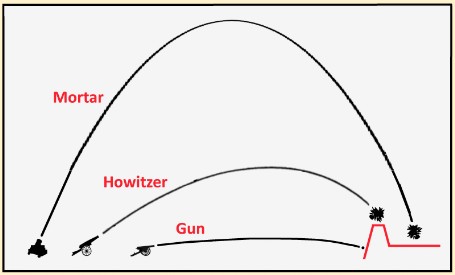
During the Franco-Spanish siege of Gibralatar of the late-18th Century ("The Great Siege"), Gibraltar was armed with three classes of artillery pieces each of multiple calibers. Guns were flat-trajectory weapons that fired anti-personnel "grapeshot" (pellets), slugs to batter fortifications, and contact-explosive rounds. Mortars were high trajectory weapons used to hit targets behind obstacles (hills, mounds, and walls). Howitzers, the third artillery class, generally fired air-burst rounds for use against trench-works and elevated enemy positions. According to Drinkwater, at the end of the siege, the British Army's artillery complement at Gibraltar was as follows:
Gibraltar Artillery of "The Great Siege" 1779-1783
| Guns | Howitzers | Mortars | |||||||||
Designation | Caliber | Number | Designation | Caliber | Number | Designation | Caliber | Number | |||
| 32 pounder | 162mm | 77 | 10 inch | 254mm | 19 | 13 inch | 330mm | 29 | |||
26 pounder 24 pounder | 152mm | 149 | 8 inch | 203mm | 9 | 10 inch | 254mm | 3 | |||
| 18 pounder | 139mm | 113 | 5.5 inch | 140mm | 4 | 8 inch | 203mm | 13 | |||
| 12 pounder | 121mm | 74 | 5.5 inch 4.5 inch 4.0 inch | 140mm 114mm 102mm | 65 | ||||||
| 9 pounder | 107mm | 16 | |||||||||
| 6 pounder | 86mm | 31 | |||||||||
4 pounder 3 pounder | 76mm 63mm | 61 | |||||||||
Total | 521 | 32 | 110 | ||||||||
Though late 18th-century Gibraltar was armed with 663 guns, its armament then was far less effective than it was in the early twentieth-century when the fortress had only 42 guns. All artillery guns of the 1780s were smooth bore (inaccurate) and short range (no more than one mile). Also, all were muzzle-loaders and because of recoil, had to be repositioned after each firing. Accordingly, rate-of-fire then was not measured in rounds-per-minute but minutes-per-round. Finally, for explosive rounds, the fusing was unreliable and airbursts were haphazard while contact-bursts often failed. The guns of 1904 Gibraltar were rifled (great accuracy) and were breach loaders with recoiling barrels (quick-firing). Fusing technology had improved to the point that gunners could be fairly sure of where an air-burst would take place. Finally, gun manufacture had improved to the point where the heaviest guns could hit targets 20-miles distant.
Rounds fired by the new 9.2" guns could hit North Africa. Now, after 200 years, British Gibraltar could actually close the Strait to shipping. With Gibraltar and the Suez Canal in British possession, the UK was the gatekeeper of both ocean entrances to the Mediterranean until 1956.
n/ During the Second World War, British possession of Gibraltar effectively kept German submarines, based on the Atlantic and North Sea coasts, from entering the Mediterranean. For a fictional portrayal of a German U-Boat's attempt to cross the Strait of Gibraltar in 1941, see Wolfgang Petersen's excellent film, Das Boot (Bavaria Film, Radiant Film, and Westdeutscher Rundfunk, 1981).
Sources
Bradford, Ernle. Gibraltar the History of a Fortress. New York: Open Road Media, 1971.
Drinkwater, John. A History of the Siege of Gibraltar 1779-1783, Revised Ed. London: Murray, 1905.
Finlayson, Clive and Darren Fa. The Fortifications of Gibraltar 1068-1945. Botley, UK: Osprey, 2006.
Maurice-Jones, K.W. The History of the Coast Artillery in the British Army. Uckfield, UK: Naval & Military Press, 2012.
Riley, Ray, ed. Gibraltar as a Naval Base and Dockyard. Portsmouth: Naval Dockyard Society, 2006.
Documents on Other Websites
To download the file, click on the document name or its website icon. The file will open from the other website in a new browser window. See Download Instructions if you're unfamiliar with the website.
John Drinkwater, London: Murray, 1861. This is the first edition.

Plan of fortifications by the Royal Engineers. UK National Archives MPH 1/23.

Links to Other Websites
Note: The webpages will open in new windows.
Click on the link to go to that page of the website. Click on the icon to go to the website's home page.
Page on the Gibraltar National Museum's website.

Page from Abandoned Spaces, a website of Timera, Inc. "devoted to urban exploration and the places that people overlook or have forgotten."

Fortifications of Gibraltar Group Podcasts
Pages on the podcast website of the Gibraltar Heritage Trust on the work of the Fortification of Gibraltar Group to restore abandoned fortifications.
Podcast 1 of 2 (29 minutes)
Podcast 2 of 2 (30 minutes)